
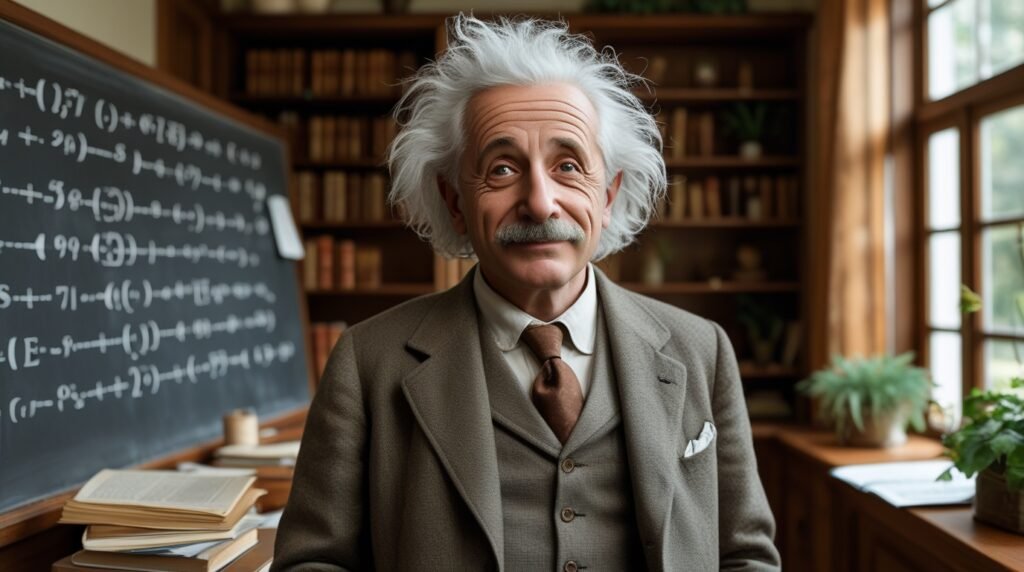
The name Charles Quincy Ascher Einstein might sound like an amalgamation of some of the most influential minds in history. It evokes thoughts of intellectual brilliance, innovation, and an unyielding curiosity about the natural world. But what if such a person existed—someone who brought together the pioneering discoveries of Charles Darwin, the groundbreaking physics of Albert Einstein, and the philosophical musings of others who shaped our understanding of science, society, and the universe?
In this article, we will explore the fictional life of Charles Quincy Ascher Einstein, a character who could have revolutionized multiple fields, from biology to physics and beyond, in an era where boundaries between disciplines were often blurred, and interdisciplinary thinking was the key to groundbreaking discovery.
The Early Years: A Life of Curiosity
Born to a family of humble means in a small, unassuming town, Charles Quincy Ascher Einstein was always a curious child, fascinated by the natural world. From a young age, he exhibited an extraordinary capacity for learning and a desire to understand the mechanics behind the world’s mysteries. Whether he was experimenting with plant growth or trying to understand the mechanics of celestial bodies, young Charles’ interests spanned both the micro and macrocosm.
Much like Charles Darwin, who sailed to the Galapagos Islands to gather evidence for his theory of evolution, Charles Quincy was drawn to nature and its complexities. His early experiments—some of which resembled Darwin’s fascination with the diversity of life—led him to explore the question of how life evolves and adapts. He was particularly inspired by the work of Darwin and Mendel, seeking to bridge the gap between genetics and evolutionary theory in ways that would lay the foundation for new scientific breakthroughs.


Education and Formative Experiences: The Melding of Disciplines
As a young man, Charles Quincy Ascher Einstein attended some of the most prestigious universities of his time, combining classical education with his thirst for knowledge. While attending Cambridge University, he found himself drawn not only to the biological sciences but also to the cutting-edge theories of Albert Einstein. Einstein’s work on the theory of relativity, and his pioneering ideas on the nature of space-time, captured Charles’s imagination. It wasn’t long before Charles began to ask the big questions: Could the principles of evolution and the laws of physics be connected in ways not yet imagined?
Charles’ education in both biology and physics gave him a unique lens through which he began to view the world. Unlike many of his contemporaries, who were firmly entrenched in either the biological or physical sciences, Charles saw no boundary between the two. He theorized that the universe, in all its complexity, was a product of both physical laws and the principles of natural selection.
The Great Synthesis: A Theory of Universal Evolution
By the time Charles Quincy Ascher Einstein had reached his early thirties, he had already made significant contributions to science. His greatest achievement was the Theory of Universal Evolution, which combined Darwin’s principles of evolution with Einstein’s theory of relativity and quantum mechanics.
Charles proposed that not only did biological organisms evolve through natural selection, but the very fabric of the universe itself was subject to evolutionary principles. He argued that the universe had evolved in the same way living organisms did: through a process of continuous adaptation and change. While Einstein had already redefined how we think about space and time, Charles took things a step further, positing that the universe itself was a living, evolving entity—an organism in its own right, influenced by the same evolutionary principles that govern life on Earth.
This bold and interdisciplinary theory brought together physics, biology, and philosophy, arguing that the fundamental laws of the universe were not static but were in a constant state of flux and transformation. The concept of “universal evolution” suggested that space-time itself, like living organisms, could undergo transformation, adaptation, and even evolution.
The Philosophical Impact: A Mind Beyond Boundaries
Much like Einstein’s philosophical reflections on the nature of the universe and Darwin’s contemplations on the meaning of life, Charles Quincy Ascher Einstein began to contemplate the very essence of existence. His theory not only had scientific implications but also posed profound philosophical questions about the nature of life, consciousness, and existence.
Was the universe conscious? Could evolution be the driving force behind all matter, not just living organisms? These were the kinds of questions Charles raised, sparking debates in academic and philosophical circles worldwide. His work was seen by many as a bridge between the scientific and metaphysical worlds, inspiring countless thinkers to consider a broader view of the universe and our place within it.
Legacy and Lasting Influence
Though Charles Quincy Ascher Einstein may not have existed in real life, the idea of a person who could combine the intellectual legacies of Darwin, Einstein, and others is both inspiring and thought-provoking. If such a person had existed, their impact on science and philosophy would likely have been profound, pushing the boundaries of both fields and fostering a deeper understanding of the interconnectedness of life, the cosmos, and the very laws that govern existence.
Charles’ greatest legacy would not have been a single discovery or theory but the very idea that all fields of knowledge are interconnected. His work would have inspired future generations of scientists to look beyond the walls of their disciplines and consider the broader questions of existence. In the age of interdisciplinary collaboration, his fictional character serves as a reminder of the importance of blending ideas from various fields to push the frontiers of human understanding.

Conclusion: The Unseen Genius
While Charles Quincy Ascher Einstein is a fictional character, the concept of a mind that bridges the gap between multiple scientific domains is a powerful one. The world of science, like the world of fiction, is constantly evolving, and in many ways, the greatest minds are those that can see beyond the conventional boundaries that society places around fields of study.
In imagining a character like Charles Quincy Ascher Einstein, we are reminded that true innovation often comes from combining knowledge, ideas, and philosophies from multiple sources. Whether it’s in the field of physics, biology, or philosophy, great discoveries are made when we dare to look at the universe not as separate parts, but as a unified whole—constantly evolving, like life itself.